
Business Operations Reality
Every business has a problem. Your team spends 40 to 60 percent of time on repetitive tasks. These tasks require no human intelligence. Sorting email, entering data, and scheduling appointments take up hours. Processing invoices and answering support questions consume your budget.
Spending 20,000 to 30,000 dollars per employee on these tasks is common. AI handles this work for pennies.
Specific Tasks for AI Automation
Customer Service and Communications
Automation Rate: 50 to 70 percent
AI handles:
- First line customer questions via chat and email.
- Ticket categorization and routing.
- Personalized FAQ responses.
- Follow up emails and confirmations.
Example: An e-commerce company reduced support workload by 63 percent. The AI agent handles order status and returns. Human agents focus on complex cases. This saves 25 hours per week per representative.
Data Entry and Document Processing
Automation Rate: 60 to 80 percent
AI handles:
- Invoice processing and data extraction.
- Receipt scanning and categorization.
- Form submissions to databases.
- Document filing.
Example: An accounting firm processes 300 invoices monthly. The AI agent extracts vendor names and amounts. Processing time dropped from 15 minutes to 2 minutes of review. This saves 65 hours per month.
Scheduling and Calendar Management
Automation Rate: 70 to 90 percent
AI handles:
- Meeting scheduling based on availability.
- Notifications for conflicts.
- Resource booking.
- Agenda preparation.
Example: A consulting firm uses an AI agent for all client meetings. Clients talk to the system to book slots. The agent checks availability, books the slot, and sends invites. This saves 8 to 12 hours per week for executives.
Sales and Lead Qualification
Automation Rate: 40 to 55 percent
AI handles:
- Initial lead response and qualification.
- CRM updates.
- Follow up sequences.
- Meeting note summaries.
Example: A software company responds to leads within 60 seconds. The AI agent asks qualifying questions and books demos. Conversion rates increased by 34 percent. This saves 15 hours per week per sales rep.
Internal Operations and HR
Automation Rate: 45 to 60 percent
AI handles:
- Employee onboarding workflows.
- Time off requests.
- Policy questions.
- Training schedules.
Example: An HR department reduced onboarding from 2 weeks to 3 days. The AI agent collects forms and sets up access. This saves 20 hours per new hire.
ROI Analysis
A company with 25 people has these costs:
- Manual tasks cost 150,000 dollars annually.
- Errors cost 25,000 dollars.
- Slow responses cost 50,000 dollars.
- Total cost is 225,000 dollars per year.
Costs with AI:
- Development costs 30,000 dollars once.
- Operations cost 6,000 dollars per year.
- Employee time costs 60,000 dollars.
- First year cost is 96,000 dollars.
- Yearly cost is 66,000 dollars.
First year savings are 129,000 dollars. This is a 57 percent reduction. The ROI is 330 percent in the first year.
AI Agents Versus Simple Automation
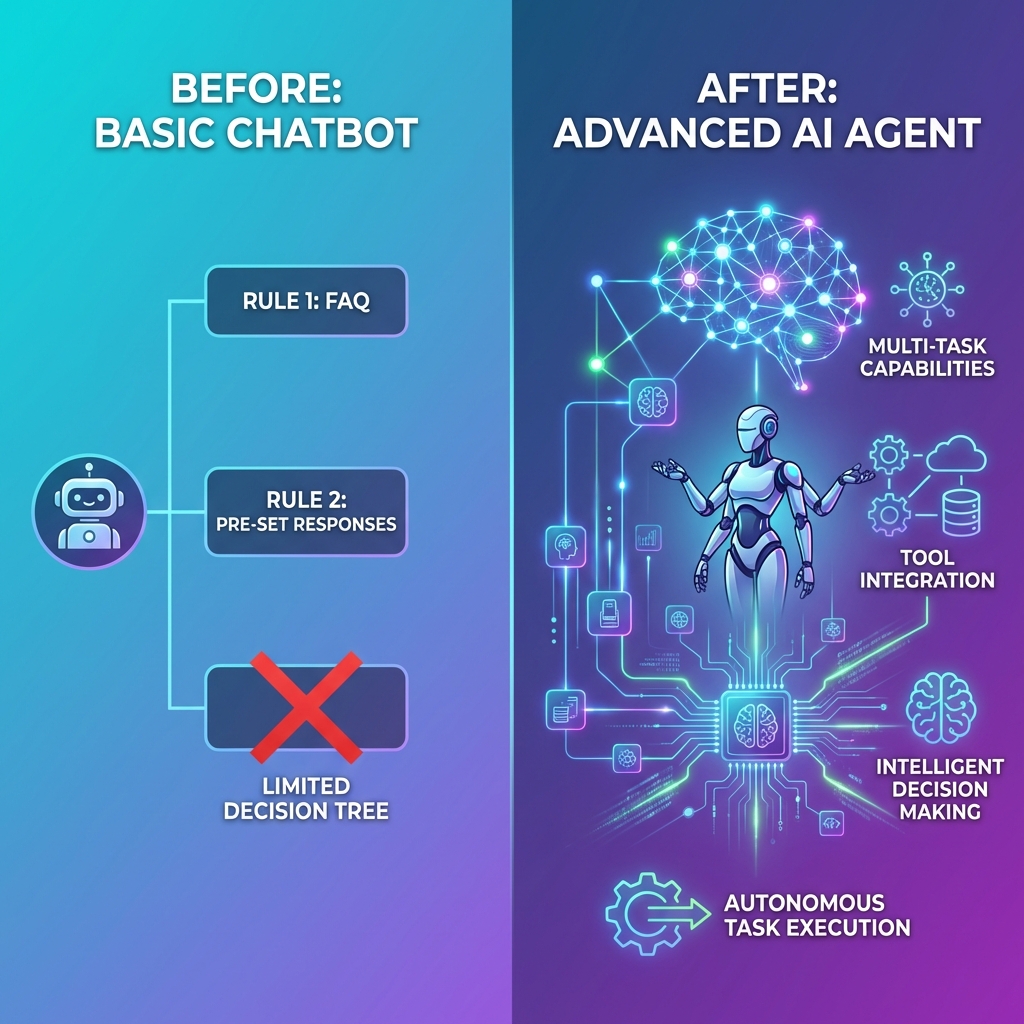
Simple automation follows rigid rules. The system breaks when inputs change. The software fails with ambiguity.
AI agents understand intent. These systems adapt to input variations. They learn from feedback. They handle complex reasoning. They connect multiple systems at once.
Implementation Strategy
Phase 1: Single Process Automation
Identify your highest volume process. Focus on customer questions or scheduling. Measure your current time and error rates. Deploy an AI agent for one workflow.
Phase 2: Training and Optimization
Monitor performance daily. Refine responses based on edge cases. Gather team feedback. Document your savings.
Phase 3: Expand Scope
Add more workflows based on results. Link agents with your CRM or helpdesk. Train your team on oversight protocols.
Phase 4: Continuous Improvement
Perform regular audits. Expand to new departments. Update capabilities as your needs change.
Common Concerns
Does AI replace teams?
No. AI agents handle repetitive work. Your team does high value work requiring creativity and decision making.
Is data secure?
AI solutions run on your infrastructure with encryption. You keep control of your information.
Is this hype?
Accounting firms and medical practices use AI automation today. The technology works.
Competitive Reality
Your competitors use these tools. Faster responses and lower overhead give them an edge. They scale without hiring. They keep margins high with competitive pricing.
Next Steps
- Audit your processes. Track where your team spends time.
- Identify quick wins. Look for high volume tasks.
- Calculate your ROI. Use your salary costs in the formula.
- Start small. Prove value with one workflow.
We build custom AI systems for your business processes. Our methods show ROI within 90 days.
View AI Integration Services or Schedule a Strategy Call to discuss your opportunities.
AI agents handle repetitive tasks. Employees focus on meaningful work. Your business gains a competitive edge.