The Chatbot Problem
Many businesses added chat widgets to their websites recently. The goal was instant support and lower costs. Most systems failed.
Traditional chatbots often lead to dead ends. A user asks to change an address. The bot fails to understand. The user closes the chat and calls support.
These systems are simple search engines. They lack intelligence. AI agents are different. Your business needs the better category.
Chatbots Versus AI Agents
Traditional Chatbots
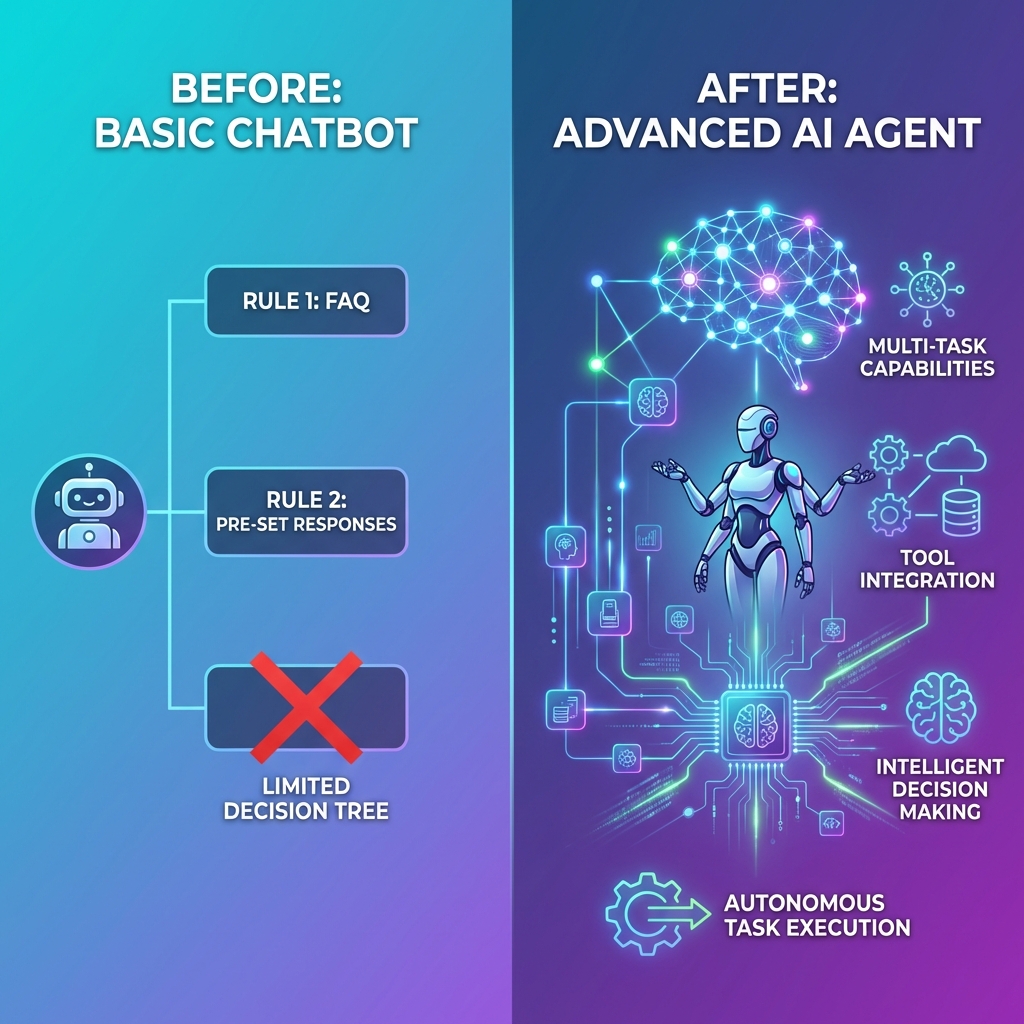
How They Work These systems follow rigid rules. If a user says one thing, the bot says another. They match keywords to pre written text. They fail with context and nuance. Changes require manual updates.
Capabilities
- Answer simple FAQs.
- Direct users to articles.
- Collect names and emails.
- Hand off to humans.
Limitations Systems take no action. They only provide information. They fail to learn. Multi step requests are impossible. Users get frustrated. Support teams deal with more work.
AI Agents
How They Work Agents use large language models. They understand natural language. They maintain context. They reason through needs. They connect to systems to take actions. These systems learn from feedback.
Capabilities
- Understand complex requests.
- Access real time data like orders and inventory.
- Execute tasks like refunds and scheduling.
- Adapt to user communication styles.
- Handle edge cases with reasoning.
- Escalate with full context.
Integration with CRMs and billing is standard. Autonomous decisions happen within your boundaries. Workloads drop.
Real World Comparison
Customer Request: I ordered two laptops. I only need one. Cancel part of the order and refund me.
Traditional Chatbot Response
The bot sees the word order and refund. The bot suggests articles on tracking and policies. The software asks if you want a human. Outcome: User frustrated. Ticket created. Human spends time reading history. Resolution takes 24 hours.
AI Agent Response
The agent understands the request. The software pulls up your order. The system identifies items and status. The system asks to confirm the partial cancellation. The agent processes the cancellation. The refund goes to your card. A confirmation email arrives. Outcome: Issue resolved in two minutes. No human needed. User happy.
Five Tests for AI Agents
- Variation Test: Ask one question three ways. Chatbots get confused. AI agents understand the intent.
- Action Test: Ask the system to take action. Chatbots fail at these tasks. AI agents execute the requests.
- Context Test: Have a long conversation. Chatbots fail on the second part. AI agents remember the context.
- Edge Case Test: Ask something unusual. Chatbots break. AI agents access your account and identify the problem.
- Learning Test: Ask: Does this improve from feedback? Chatbots involve manual coding. AI agents learn from ratings and success.
What to Build in 2026
- Customer Questions: Build an AI agent with system links. Access databases. Execute refunds. Reduce ticket volume by 50 to 70 percent.
- Sales Qualification: Build an AI agent to engage leads. Score leads based on the talk. Link to your CRM and calendar. Increase conversions by 25 to 40 percent.
- Internal Operations: Build an AI agent for employee requests. Link to HR and technology tools. Save 15 to 25 hours per week per department.
- Shopping Assistant: Build an agent for e-commerce. Search catalogs. Check inventory. Assist with checkout. Increase conversion rates by 20 to 35 percent.
Agent Architecture
- Language Model: The brain. Capable models handle reasoning.
- Knowledge Base: The memory. Includes your documents and real time data.
- Integration Layer: The hands. Connections to your CRM and APIs.
- Guardrails: The safety system. Prevents unauthorized actions.
- Feedback Loop: The improvement engine. Tracks success.
Common Mistakes
- Avoid calling a simple chatbot an AI agent. Use the five tests.
- Avoid expecting 100 percent automation. Plan for 60 to 80 percent.
- Link your systems. The agent needs to read and write data.
- Provide training data. Use real conversations.
- Plan for ongoing monitoring.
Build Versus Buy
- Buy Off the Shelf: Standard needs like scheduling suit these platforms. Deployment is fast. Budget is smaller.
- Build Custom: Unique workflows require custom builds. Deep integration is possible. You keep full control of data. Economics improve at scale.
Competitive Reality
Businesses using chatbots are at a disadvantage. Customers see the difference. AI agents resolve questions instantly. Satisfaction scores rise.
Next Steps
- Identify interactions for automation. Calculate current costs.
- Research platforms. Use the five tests.
- Calculate ROI. Factor in experience and churn.
- Choose your approach. Start with a proof of concept.
We build intelligent AI agents. They link to your systems and solve problems. View our AI services.
The era of useless chatbots is over. Winning businesses use true AI agents. Lead your industry with better technology.